Showing posts with label Malaysia. Show all posts

Monday, August 16, 2010

Farewell to you, Malaysia


15-Aug- 2010

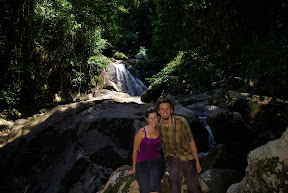
“Goodbye my lover, Goodbye my friend.” With guitars in hand this is what the happy staff at Uncle Tan’s sang to us as we boarded our boat and headed downstream along the Kinabatangan River. Needless to say, we enjoyed our time in Malaysia immensely. With a few exceptions, getting from place to place is efficient, and food and accommodation are a good value. Malaysia’s National Parks, though fairly disorganized and operated by a frustrating bureaucracy, are spectacular and provided us with our most memorable days. What else can a couple of nature nerds like us ask for?

As we sit now in Yogyakarta on Java, Indonesia we already miss Malaysia. Parroting the governator, “We’ll be back…” someday. Holding back the tears (?) but happily drinking a cheap beer we have prepared a few statistics and a list of Best’s and Worst’s from our travels in Malaysia.

By the numbers

Days in Malaysia: 42

National Parks/Natural Areas Visited: 10

Days Spent in Nature (including the Perhentian Islands): 27 (64%!)

Stomach Illnesses: 2 (1 for each of us)

Flights: 3

Train Rides: 1

Boat Trips: 13

Bus Rides: 18

Average $ Spent per Day (excluding flights): $74

Cheapest Hotel Room: $11 (in Kota Bahru)

Cheapest Dinner (for 2): $3.20 (in Kuching)

Photos Taken: 2,612 (an average of 62/day)

Best’s

Best Day

Nick: Our first day in Bako NP (Nepenthes galore!)-hiking the Lintang Trail

Rachel: Hiking in the forests of Mt. Kinabalu NP (orchids galore!)

Best City/Town

Nick: Kuala Lumpur

Rachel: Kuching

Best National Park

Nick: Gunung Mulu NP

Rachel: Mt. Kinabalu NP

Best Meal

Nick: Mango Curry at Mama’s Chalets on the Perhentian Islands

Rachel: Black pepper flat noodles with fried tofu in Kuching

Best Wildlife Experience

Nick: Early morning wild orangutan sightings on the Kinabatangan River

Rachel: Almost stepping on a bearded dragon digging a nest in Gunung Gading NP

Best Hike

Nick: Lintang Trial, Bako NP

Rachel: Ligawu River Trail, Mt. Kinabalu NP

Best Surprise

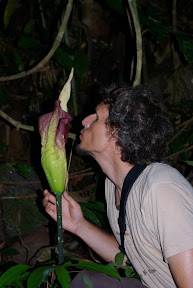
Nick: Seeing Amorpohophallus hewitii in bloom in Gunung Gading NP

Rachel: The feeling of sitting on the ocean floor while scuba diving

Best Hotel/Hostel

Nick: Lodge 121, Kuching

Rachel: Lodge 121, Kuching (1st runner up, Royal Mulu Resort)

Place to which we’d most like to return

Nick: Gunung Gading NP, when Rafflesia is in bloom

Rachel: Sabah, Borneo

Worst’s

Worst City/Town

Nick: Kuala Tahan

Rachel: Kuala Tahan

Worst Meal

Nick: Disgusting slimy, fishy, tomato noodle dish in Kuching

Rachel: Snotty, fishy noodle soup in KL (I couldn’t even eat it)

Biggest Waste of Money

Nick: CPH Travel evening boat ride, Kuching (Lonely Planet, you really missed the boat on this one)

Rachel: CPH Travel evening boat ride, Kuching

Most Disappointing Moment

Nick: Not getting to climb to the Pinnacles in Gunung Mulu NP

Rachel: Being sick in the Cameron Highlands the entire time we were there

Worst Hotel/Hostel:

Nick: KRS Pines in the Cameron Highlands (arguing staff, cubicle room)

Rachel: The Bennerat Lodge near Gunung Mulu NP (overpriced)

Friday, August 13, 2010

Gunung Gading, try saying that three times fast!


12-13 August 2010
"It's like walking in a sauna" -Nick

We found ourselves heading uphill on yet another rocky trail at yet another national park to the sound of of a cicada whose reverberations mimicked the sound of someone strumming a single note on a sitar.

We had hopped on a bus for an overnight trip to Gunung Gading National Park which is widely known as one of the premier spots for spotting blooming Rafflesia, the "largest flower in the world" that of course stinks of rotting flesh. Unfortunately, this would not be blooming for "maybe two weeks, maybe next week, we just don't know". We headed there anyway, a botanical fools-quest.

Sadly, the park officials at the park entrance again reiterated that the Rafflesia were not blooming. However, almost as a consolation prize (though equally as cool), we were lucky enough to spot a blooming Amorphophallus hewittii (common names: Borneo titan flower or (my personal favorite) giant voodoo lily). This plant also smells like rotting flesh (yay!) and we had been searching for it ever since spotting its leaves and fruits in Gunung Mulu National Park!!


Besides the Rafflesia, Gunung Gading boasts a few beautiful waterfalls, some nice overlooks, swimming holes, and a summit trail. We walked the waterfall trail, had lunch at the beautiful and creatively named "Waterfall #7" and headed directly for the Gunung Gading summit. Don't laugh, but we did not make it to the summit. We trudged upwards for a few hours, sweating as if we were sitting in a sauna, getting dizzy and, in our delirium, jumping every time we spooked a skink or lizard. We had less than a liter of water and 800 meters to go. Somehow, the 3km (about 1.4 miles) trail had taken us about 3 hours to complete...we must have forgotten how to walk (or someone forgot how to count). After resting on a giant tree root for about 15 minutes, we choose to abandon the summit. There was no view anyway. We headed downhill, walking at a pace of 1km per hour downhill, apparently. Note to self: Do not trust Malaysian national park maps.

About halfway down the trail we spooked some white/pink colored bats (I swear its true)!! They swirled around us for a few seconds - we mystified, they horrified - before they found another resting place. Just a few moments later I gasped. In the middle of the trial in front of us was a beautiful green lizard who bore a striking resemblance to our poor sweet water dragon. More exciting was that this female lizard was digging a hole for what we presumed were her eggs! After getting over the initial shock of our presence she continued to dig with her mouth and hands as we looked on (we will try to post this video, but we are having some resolution problems at the moment).

Leaving her to the important work of burying her eggs (something we know nothing about), we continued on the trail and Nick spotted the aforementioned giant voodoo lily!! We were hot, tired, out of water, drenched in sweat (and I mean literally), but felt like we had found the pot of gold at the end of the rainbow.

After a cold shower and some well deserved Oreo cookies, we plotted our search for the Rafflesia the next day.


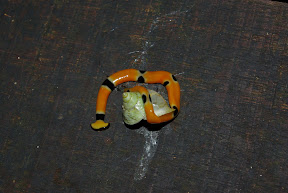
While the Rafflesia were not in bloom during our visit, our encounters along the way made this trip extremely rewarding. While Nick photographed an orange and black banded hammerhead flat worm this morning (we had no idea what this was at the time) I began to realize what made this trip to Borneo so special to me. In the past three weeks I have recaptured the 8 year old child with a butterfly net wondering in my parents big backyard. We have seen so many strange and beautiful animals, plants, insects, reptiles, and "what is that's" that I have literally, cooed, giggled, squealed and jumped up and down at least fifty times. For the nature lovers out there- those that don't mind being dirty, sweaty, and stung by fire ants - Borneo is heaven on Earth!

Tuesday, August 10, 2010

Beach Day at Bako


10-11 August 2010
As it is such an easy day trip from Kuching, we headed back to Bako National Park to visit one of its beautiful beaches! We woke up early and went down to the waterfront to catch the bus that is supposed to arrive somewhere between 7 and 7:30am. We arrived at the park and headed directly for the Lintang trail (hoping to avoid any further harassment by the macaques). We branched off from that trail after a few kilometers for the Telok Pandan Besar overlook and then onto the Telok Pandan Kecil beach.

As and aside, I would like to take a moment to comment on the trail maps, specifically the trail distances that are repeatedly incorrectly reported in many of the national parks we have visited. It would take a very small effort to fix these issues, ranging from the apparent use of "as the crow flies" distances to what appear to be guesses (if you are reading this Ingrid, we think your idea of starting an NGO to do international GIS work for national parks, etc. is a genius idea - lets get some grants!).

Anyway, we (Nick, Lauren from Canada, and I), hiked up to the kerangas, drooled over the pitcher plants, sweated our brains out, and then headed to the beach! We were so lucky to be the first to arrive that day!!! We arrived at this tropical paradise and had the beach to ourselves for about twenty minutes before boatloads of tourists arrived. We sunbathed, floated in the warm green-tinged water, admired the sandstone formations, watched armies of crabs scurry across the beach, hunted for cycads, and sunbathed some more. As noon approached, the sun became overwhelmingly hot (as it tends to do near the equator) and Nick was finally able to put his hiking pole/umbrella idea into action. He quickly rigged up our two hiking poles (brought specifically for the beach, not the hike) to our two umbrellas and we were the envy of the beach in a matter of seconds as we enjoyed the shade and the others retreated back to their boats in search of a less sweltering location.


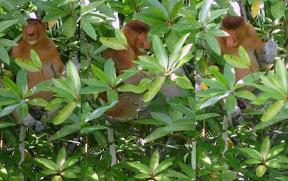
After hiking through the stifling heat to catch our boat (now wishing we had paid the 7 ringgit for a boat), we were greeted by a troop of proboscis monkeys and finally got a good look at a male! Check out that nose!


On our way home, we stopped at the Kuching Food Festival and grazed on chicken satay, sausages, fried yam on a stick, deep fried ice cream, mini fish burgers, honey mustard nachos, sweet peanuts in a gluten bar(?), sticky rice roll with meats, sweet rice with banana, and many more. Yum!!

This evening we embarked on a river boat cruise down the Santubong River and were lucky enough to see Irrawaddy dolphins, proboscis monkeys, and fire flies. The tour (run by CPH Travel) was over priced and crowded, but as the sun went down the stars, fire flies, phosphorescence in the water, lightning in the distance, and fireworks to mark the 1st day of Ramadan brought us back to the magic that is Borneo.

Tomorrow we head out for an overnight trip to Gunung Gading National Park to see the buds of Rafflesia (sniff sniff, it's not blooming) and hike on its numerous trails.

Sunday, August 8, 2010

(Bacony)-Bako National Park


7-August-2010

After an early morning walk, van ride, and boat trip we waded ashore at Bako National Park and paid our entrance fees. Still feeling marginally awake we watched with awe as a herd of Borneoan bearded pigs advanced on the park headquarters and proceeded to munch on coconuts and other plant material within feet of us tourists. After numerous encounters with wild pigs in the field back home, both Rachel and I were not too interested in getting to know the temperament of these Borneo-endemic swine. These guys and gals were big (some of them must have weighed well over 300 pounds), and they pretty much look like "normal" wild pigs with goatees. This was our introduction to Bako, Sarawak's first national park, perched on a peninsula that juts out into the South China Sea.

As we were observing the pigs, movement in the trees signaled monkey's overhead. Gazing upward we expected to see the common, long-tailed macaques. Surprise! Advancing overhead was a troop of proboscis monkeys. Proboscis monkeys are truly spectacular animals. Endangered and restricted to a limited number of locations on Borneo, they are easily recognized by their enlarged noses. The proboscis males of this species can get quite large, such that they look like they are wearing large sausages attached to their faces. We watched and took photographs as these gentle herbivores munched on leaves and swung around in the trees above. All of this and we were still just steps away from the park headquarters.

We began our long day hike with our friends and traveling-companions, Lauren and Elliot, along the Lintang and Telor Paku trails eager to explore more of Bako's natural wonders. Hiking first on Telor Paku we emerged from sandstone cliffs onto one of the most idyllic beaches we have ever visited. We were tempted to spend the entire day in this spectacular setting of clean sand ringed by dense cycad-rich hillsides and bordered by picturesque sandstone formations. The one main deterrent to a lazy day on the beach was the presence of saltwater crocodiles in Sarawak's coastal waters-yikes!

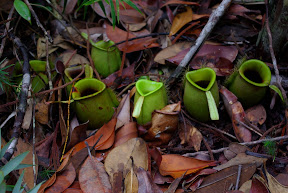
Continuing our hike on the Lintang Trail we climbed a moderate-sized hill and emerged into a Mars-esque landscape of exposed pock-marked sandstone filled with water from the previous night's rain and stunted vegetation. We soon realized that we were in Bako's heralded keranga habitat. The keranga habitat we observed in Gunung Mulu National Park was much less harsh and was lush in comparison to this landscape. It wasn't long before we began to notice pitcher plants of the genus, Nepenthes. We had heard from a fellow traveler that there were pitcher plants on the trail, but were were not expecting the botanical wonders of the next several hours. For the next 3-4 hours we hiked in and out of Nepenthes habitat observing millions of pitcher plants. Not trying very hard we tallied at least seven different species (with two species observed in Mulu, that makes a total of nine species for the trip) of pitcher plants. The hike even threw in some sundews (Drosera) and Pinguiculas to satisfy our appetite for carnivorous plants.

The variation in Nepenthes that we observed was outstanding. They occupied numerous habitats-from dense forest to exposed swampy areas cloaked with moss. We found them growing on bare soil and hanging vine-like from tall trees. Filled with water and partially-digested insects they ranged in size from the size of my pinky-finger to nearly the size of my head. And, they ranged in color from plain, pale green to a pattern which resembled a red and green tie-dyed t-shirt.

Hiking back to park headquarters though a forest rich with so uncountable species of palms we observed another troop of proboscis monkeys (one female carrying a baby-so cute) parading through the canopy. What a fitting end to a memorable hike!

Hungry from all of the hiking and botanizing the four of us stopped in for a snack at the park's cafe. If you ever wanted to see monkeys gone bad this would be a good place to start. The macaque problem at the cafe is so bad that they have even hired a guy to sit out front and protect tourists from monkey attacks by pelting the constantly-advancing macaques with rocks.

Q: What do you do for a living?
A: Oh, I work at a restaurant.
Q: Cool, are you a waiter?
A: Not exactly, I shoot monkeys with a slingshot.

Okay, calm down PETA, no monkey's were harmed in the making of this blog post. Seriously, macaques are no laughing matter. We observed numerous near-attacks on tourists while we sat at the cafe. These little guys are scary. Lauren even had one of the little buggers jump onto her backpack early in the day because she was carrying an apple. Watch your back.

Sitting on the beach, waiting for our boat, staring at the ocean's beauty we chatted about the great hike and maintained a state of "constant vigilance" to ensure that no macaques were sneaking up on us. Not far behind us, a troop of proboscis monkeys grazed in the trees as we boarded our boat back towards Kuching.

Friday, August 6, 2010

Caves, Caterpillars, and Kerangas


1st -6th August 2010

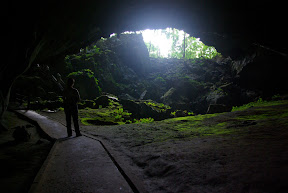
Landing on the small airstrip, surrounded for miles and miles by meandering rivers and rainforest, we were ready for an adventure. Because travel arrangements are oddly difficult to this very popular national park, we had a tour company arrange our accommodation, our visits to the caves, and our trek to the Pinnacles. We were picked up, informed that something was wrong with our budget accommodation and that we would instead be staying at the luxury resort – the Royal Mulu. From the airport we headed out to see the Deer Cave (with the largest opening of any cave in the world) and watch the exodus of over 5 million bats at sunset. We quickly changed our shoes and headed directly to Gunung Mulu National Park. The Deer Cave is full of beautiful stalagmites and stalactites, millions upon millions of bats clinging to the high ceilings, and of course tons of guano! We were pleasantly surprised as it did not smell as horrible as we imagined. We exited the cave as the sun was setting and the bats had already begun their mass exodus. Besides the indescribable sight of these hungry bats, the cave itself was just gorgeous. As we reached the bat viewing platform, many of us laid down on the wood planks and watched the constant stream of bats for about an hour.

We were dropped off at the Royal Mulu Resort, checked into our rooms and handed meal vouchers. We really did not know what to expect – as we had heard that this spot was overpriced but also very nice. We had paid for budget accommodation and were needless to say pretty excited about our room and the delicious buffet dinner (they even had masterfully-roasted turkey) and yummy breakfast (waffle bar!!!) we enjoyed during our one night stay. In the morning we were picked up in a longboat and headed upstream to the Clearwater Cave (a river runs through it) and the Cave of the Winds (windy in one spot-imagine that) – both of which were extremely beautiful. After lunch, our five person group hopped back into a longboat for the hour or so ride to the trailhead for Camp 5 – the base for the Pinnacles Trek.

The longboat ride to the trailhead was gorgeous. We traveled up Melinau River, a much smaller river than any we had “longboated” up before. As this shallow, shady river wound its way upstream we took in views of the limestone formations, watched the butterflies and dragon flies who raced our boat, counted the multitude of giant logs that lined the banks and jutted out of the river, and watched swaying adventitious roots as they reached desperately for the river. We walked a quick 9km or to Camp 5 through dense rainforest and arrived in the mid afternoon to ready ourselves for the Pinnacles Trek early the next morning.

The Pinnacles Trek ascends over 1000 meters up the vertiginous Gunung Api (gunung is Malay for mountain) in just 2.5km (just over a mile) to the Pinnacles – limestone spires that are the remnants of the interior of an ancient collapsed cave. While only about a mile long, the uphill stretch takes around three hours on a 75% slope. The hike has an epic reputation. Scrapes and broken bones are not uncommon. Deaths are rumored but our guides refused to speak of these alleged incidents out of superstition. Needless to say, we were a little apprehensive going into our bid to view the Pinnacles.

While the uphill is daunting, the downhill slips and slides on muddy, mossy tree roots back down the steep gradient and can take up to five hours. Imagine – a 5km (2.3 mile) hike that takes around 8 hours. This may sound like unnecessary torture, and the guides may only allow you 30 minutes at the top to enjoy the Pinnacles, but like so many hikers before us we came to Gunung Mulu hoping to reach the top! The thing no one mentions (until you receive your briefing the evening before, after you’ve already walked the 9km to the trail head and paid the fees) is that you will not be allowed to hike if it is raining at the 6:30am departure time. Well folks, welcome to the rainforest. In fact, the area around the Pinnacles receives more than 6000 millimeters per year. Okay, do the math- that is about 20 feet of rain. Yikes!

The rain that began the day of our arrival continued through the night, and much to our dismay it was still going at our 5:30 am wake-up call. Nervous and impatient we milled around watching the rain, praying for sun, drinking weak coffee, and waiting for the verdict from the park ranger. “We are sorry to inform you that there will be no climbing to the Pinnacles today, it is just too wet. We are sorry. We know that you have come a very long way and paid much money.” You got that right, Mr. Ranger. We figure that the 22 hour downpour that canceled our hike must have amounted to about 10 feet of the area’s rain budget (maybe a little bit of exaggeration). This was the only day, so far, in our month of travel in Malaysia, in which it has rained in the morning. Was this bad luck or some sort of omen from the spirits of the Pinnacles?

The day, however, was not a total loss. In mid-afternoon, in a break in the weather, we took the opportunity to explore the Kerangas Trail with our Iban (a tribe famous for headhunting in the not so distant past) guide and some new friends-kindred spirits, the five of us bound together by dashed trekking dreams, small talk, and innumerable games of cards. The keranga geologic formation is tropical phenomenon formed by uplifted river sediments that that have been leached by 6000 mm of rain per year for many, many years. The result is very shallow, acidic soil, stunted plants, and (yahoo!) carnivorous, pitcher plants of the genus Nepenthes. Pitcher plants thrive in this tough environment by munching on insects (more Nepenthes and fewer mosquitoes please). The day was redeemed as we walked in light rain to the top of this formation, gathering leeches along the way, reveling in the unique habitat where these beautiful, carnivorous plants live.

We departed Camp 5 the next morning more than a little disappointed but ready to explore the rest of the park and eager to scrub our quickly accumulating jungle grunge of mud, sweat, and insect repellant off with a proper shower. The jungle and the landscape of Gunung Mulu National Park are undeniably beautiful. This place has caused us to slow down and take notice of the many small details that make rainforest habitats so special. Minute orchids cling to tree bark and gigantic bird’s nest ferns hang from tree branches framed by the backdrop of vertiginous limestone cliffs covered in moss. Strolling on muddy trails and wooden boardwalks we have marveled at the park’s tranquil, slow rivers that meander past gigantic old-growth trees, whose tannin-rich leaves stain the water a translucent, rich brown. Mulu is a butterfly-lover’s dream. They literally come in all sizes and colors of the rainbow. The most spectacular of which is, perhaps the Raja Brooke -with a six-inch wingspan, a black body, a neon green wings, and a firecracker-red head. And, of course, all of these butterflies spend part of their life as caterpillars. Mulu’s pallet of caterpillars-gaudy, grotesque, and gorgeous is without comparison.

More than anything Gunung Mulu National Park has taught us that joy can be found in any place that is wild and free. While we regret not having climbed to the Pinnacles, we realize that Mulu’s mountain of biodiversity is more than enough to satisfy all of our desires.

This morning (6 August), the morning of our departure from Mulu, we hiked (really we slogged through the mud) to a waterfall that flows out of an opening in the complex network of limestone caves that makes Mulu so famous. There, we were happy to meet up with some friends one last time who we've been running into ever since our visit to Teman Negara in mainland Malaysia and agreed that while the waterfall was quite short we were all curious about its underground (or in cave) origins. After lunch we rushed back to the Benerat Lodge to collect our bags and fly to Kuching on the west coast of Sarawak, Borneo. We have been looking forward to visiting the city of Kuching - Malay for "cat"- as it is full of good food, numerous national parks, hot showers, and will surely be a sweet end to our visit to Borneo and Malaysia. Meooooooooooow, that's all for now.

Saturday, July 31, 2010

Misty Mountain Hop


29-31 July
Mount Kinabalu National Park is Malaysia’s first World Heritage site and is known for its high plant diversity. The misty cloud forests of this mountainous region high in the state of Sabah are a reprieve from the sweltering heat of the lowland jungle. The main attraction here is Mount Kinabalu itself, a granitic giant towering 4095 meters high over the island of Borneo. Most come to climb the mountain – a feat that takes somewhere between 2 hours and 40 minutes if you were the winner of this year’s “great race” to the top of the mountain or two days if you prefer a more reasonable pace.

Nick and I came here for the plants, not the mountain. We spent two days exploring its mossy trails searching for miniature blooming orchids and still elusive pitcher plants. We waxed botanical and dreamed up cross-breeds of the begonias we encountered. This botanical paradise was only interrupted by steep climbs, the threat of a torrential downpour, and a leech or two. We were awestruck to happen across the fuzziest caterpillars we have ever seen and a black centipede outlined in red (check out the photo!) We were especially happy to finally recognize a few genera and were very pleased to find a number of plants in full bloom!

Tomorrow we continue our tour of Borneo’s national parks and move on to Gunung Mulu National Park. There we will fulfill a Planet Earth driven desire to watch as millions of bats depart from the parks many caves! We can only hope that it is as inspiring without Sigourney Weaver to narrate!

Friday, July 30, 2010

Up and Down the Kinabatangan River, Borneo


26-July - 29-July 2010

Four days ago we set out on boat along the mighty Kinabatangan River. The river is the color of chocolate milk, fed by runoff from the daily rains. Its banks are covered in lush forests with the eyes of numerous creatures big and small peering out at visitors as they motor past. However the forests along the Kinabatangan are a battleground where Malaysia’s growing economy and the rainforest are in constant conflict. From our narrow perspective the dark side seems to have the upper hand. In many places the rainforest is a mere strip of trees no more than 50 feet wide lining the river bank, in others the palm oil plantations (take a tour of your cupboard and I bet you can find plenty of palm oil in ingredients lists) have advanced straight to the river’s edge, and in others the trunks of large trees are stacked waiting for the logging boat to take them to market. In far too few places the forest has been untouched and remains in large continuous swathes. That said, the Kinabatangan is a magical place and the four days we spent at Uncle Tan’s jungle camp is sure to be one of the highlights of our trip.

Shortly after embarking on our trip up the river we came across a large troop of long-tailed macaques – the “cheeky monkey”-- lounging on a sand bar and cavorting in the trees. Over the course of the next few days sightings of these playful creatures would become so frequent that they would almost go unnoticed. Nearly everyone who visits the Kinabatangan hopes to catch a glimpse of a wild orangutan. At one time orangutans were abundant on the islands of Borneo and Sumatra, but now they are rare and endangered. Luck was on our side as our boat diver and cheerful guide swerved rapidly and put the brakes on the outboard motor, “Orangutan!” With our hearts in our throats we watched as three (2 adults and one baby) of these great apes moved through the canopy of a nearby tree. Spectacular!


Nearing sundown we made our way to Uncle Tan’s. The jungle camp is far from luxurious (just mattresses on the floor of wooden huts covered by mosquito nets, no running water, limited electricity-you get the picture) but it is very comfortable. The food was excellent and the camp staff was superb. In fact, the folks working in the camp must be some of the happiest people on earth. Each day we were greeted with smiles, friendliness, morning soccer (on a small sand field) and volleyball games, endless song and guitar music, and, at night, a big pail of “monkey juice” passed around to add to the merriment. These guys love the jungle and love to have a good time!

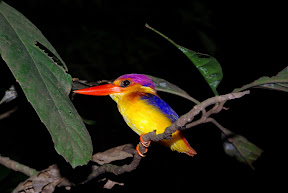
During our stay we participated in 7 boat safaris, and 3 jungle walks, which took place day and night. Sightings ranged from the fleeting glance of proboscis monkeys (a rare, Borneo endemic) leaping through the trees at sundown to a techni-colored kingfisher perched mere inches from us on a branch during our night walks (which our guide teased was a plastic bird he had placed there hours before) to countless flyovers by beautiful and charismatic oriental pied hornbills. The haunting calls of the Borneo gibbons (another primate) and their amazing speed as they swung from tree to tree will be unforgettable. The highlights of the trip occurred bright and early during the 6:30am river safaris on days three and four. On both days we had the great fortune to watch a single female orangutan feeding on fig fruit in a tree above us no more 20-30 feet away. The experience of watching these close human relatives in the wild was surreal (our DNA varies by only about 3%). All in all, we saw 6 primate species, numerous birds, lizards, frogs, crocodiles, and countless insects (see below for the complete list) during our trip.

Sitting here gazing at the mist shrouded foothills of Mt. Kinabalu we already miss the Kinabatangan. The lowland forest of Borneo, home to orangutans and countless other creatures, is an enchanting place that literally breathes biodiversity. As botanists, conservationists and lovers of nature, this habitat will hold a special place in our hearts. The Kinabatangan exists at a crossroads. Only time will tell what the future holds for Borneo’s orangutans, proboscis monkeys and gibbons.

A Partial List of What We Saw

Mammals

Borneo gibbon (seen 3 times)

Flying squirrel

Orangutan (seen 4 times, 6 individuals)

Palm civet

Pig-tailed macaque

Plant pygmy squirrel

Proboscis monkey

Long-tailed macaque

Silver leaf monkey

Birds (not an exhaustive list-we are, by no means, birders)

Bee-eaters

Black-backed kingfisher

Black and red broadbill

Blue-eared kingfisher

Crested serpent eagle

Little pied flycatcher

Oriental pied hornbill

Owls

Red fish eagle

Stork-billed kingfisher

White-bellied fish eagle

Reptiles and Amphibians

Comb-crested agamid lizard

Grass frog

Frogs (at least 4 other species)

Monitor lizard

Other lizards and skinks

Saltwater crocodile

Sunday, July 25, 2010

Welcome to Borneo


25 July 2010
After an early morning flight we arrived in Sandakan, on the island of Borneo in the Malaysian state of Sabah. We quickly made our way to Sepilok, home to one of four orangutan rehabilitation centers in the world and the starting point of tomorrow's trip up the Sungai (River) Kinabatangan (try saying that 3 times in a row). This marks the start of 3+ weeks exploring Borneo- the third largest island in the world, a haven of biodiversity, and a place where the battle between conservation and economic development is waged on a daily basis.

After settling in to Uncle Tan's, our base for the night, we set out on foot for a visit to the Rainforest Discovery Center. The Center is home to a beautiful botanical garden, several miles of trails, canopy walkways and bird observation towers. Walking on the trails amidst butterflies and scurrying lizards we arrived at the Hornbill Observation Tower. Hornbills are large forest birds with large bills, which are symbols of the islands faunal diversity. As we climbed the observation tower, perched well over 100 feet high into the tree canopy we tried to ignore the distant thunder and darkening clouds on the near horizon (it wouldn't pour on us our first day in Borneo, would it?). After minute or two at the top, we could not ignore the approaching storm. We watched as a strong persistent wind suddenly appeared and the thunder took on a more ominous tone. Just then we notices hundreds of brown "helicopters" aloft emanating from the dipterocarp trees, which dominate the forest canopy. The seeds of these trees are perfectly suited for wind dispersal and took flight beautifully in the stiff wind. Fearing the worse we hightailed it back in the direction of the Center's headquarters-hoping for a weather miracle. About half of the way back we were caught in the storm, but we were serendipitously close to a nearby shelter-yes! There, in the shelter, we spent the next hour or so-waiting out the storm. If you have ever experienced a hard tropical rain you know that rain gear is no match (you would just sweat inside it anyway) and umbrellas offer little real protection. If it weren't for the shelter we would have been drenched to the bone an hour away from home in mere seconds.

As the storm began to pass and the thunder faded into the distance we made our way back to our guesthouse. About half of the way back we noticed three large bird silhouettes in a dead tree not to far in the distance. Upon closer inspection and after viewing their shape in flight their identification was unmistakable. Hornbills!

And, so starts the Borneo portion of our adventure. Tomorrow we visit the Sepilok Orangutan Rehabilitation Center to learn about the resident great apes and the efforts to conserve them. In the afternoon we head out for 3 nights on the Kinabatangan River, where we hope to see orangutans and much more in the the wilds of Borneo.

Saturday, July 24, 2010

If you're young in KL....


24 July 2010
We arrived in Kuala Lumpur (KL) amidst preparations for a multi-block outdoor fashion show, with one of the main stages outside our 3rd story hotel room (so much for getting some sleep before our 7am flight tomorrow morning). The city is alive with young people!! If you're young and living in KL you might be hanging out with your friends amongst the hundreds of motorbikes parked along the streets, your hair gelled into a faux-hawk and hoping for a cute girl to walk by who isn't wearing a head scarf and might actually talk to you. If you're a really cool dude, you might be break dancing or Tecktonik dancing it up on the sidewalk while hundreds of people watch in awe.

We've noticed today, more than any other day here in Malaysia, the extremes of this very diverse country. We started our day in a cool climate high in the hills and wound our way down a river valley to steamy KL. While the break dancers dance and the models walk the runway, women clad in full burka-style garments watch next to girls in short see-through skirts, and both wear dizzingly high platform shoes. The woman in this country love their shoes!

We depart early tomorrow morning to Sabah, Borneo to enjoy the flora and fauna of another extreme in this delightful country.

But for now, as Lady Gaga says,

Oh oh la la la
We love designer
I need, some new stilettos
Can't walk, down the street in those
You are, who you wear it's true
A girl's just as hot as the shoes she choose

Wednesday, July 21, 2010

Taman Negara, Part 4


21 July 2010

Being stuck in Taman Negara is not a bad thing. We were supposed to move on to the Cameron Highlands today, but I came down with a bit of a stomach bug yesterday and we decided to put our travel plans on hold-just in case. It seems like rest, tlc from my dear Rachel, and a blast of Cipro has done the job and I up and at em' today.

This has enabled us to spend an extra day in Taman Negara-please hold the sympathy cards. Well, I will try to keep this short and sweet. Guess what? We went for another nice long (actually less steamy-it is a bit cooler here today) hike and absorbed more of the park's spectacular scenery. In brief, there were more plants, insects, mushrooms, flying squirrels and the like. The highlight of the day was a large spectacularly-ornamented caterpillar (nature, you amaze me).

Tonight we are off on a wildlife watching jeep safari through lands outside the park. We have a good chance of seeing leopard cats (look like leopards, but the size of house cats), snakes and possibly other animals. Wish us luck!

Tomorrow it is off to the Cameron Highlands for a taste of that natural air-conditioning that 5000 feet of elevation delivers. In parting, we really love Taman Negara and are somewhat sad to be leaving. Our first experience in intact Asian rainforest has whetted our appetites (pun intended).

Sunday, July 18, 2010

Taman Negara , Part 3


19 July 2010
Walking through the rain forest the last few days we have taken special notice of the way the forest sounds. Today we walked to a cave, Gua Telinga, and because we did not see another human for about two hours and our never-ending conversation does tend to lull while we are hiking up steep slopes in 90% humidity we both observed some new sounds and made attempts at relating them to things we have encountered throughout our lives.

As we walked today there was a tremendous number of termites, and by tremendous I mean termites marching ten rows deep for an unknown distance every couple of feet. You could usually hear them even when you couldn't see them - the sound resembled the perfect bowl of rice crispies - "snap, crackle, pop". Imagine a commercial for termite cereal! ha!

The insect sounds, cicadas and whatnot, are deafening. Half of the time it just sounds like a loud buzz, like a distant bee hive that follows you around. Or maybe like a five year old with a kazoo.

On top of the buzz there are the bird songs, most of which sound like the noises R2D2 and the guns of the troopers in the older Star Wars movies make. Others sound more like the noise that a large stone makes when it is tossed into a lake or river, splunk.

And of course, this noise never stops. And while we rambled along the tree root laden green lined path we only saw a few fleeting glimpses of birds and flying squirrels, all the while trying not to disturb the termites and the ants as large as my big toe as they went about their daily six-legged life.

The only monkeys we saw today were those using a power line to cross the river - ha! We did, however, see a dog and a cat on our walk today, both very near a settlement of the several hundred native peoples, the Orang Asli, who still inhabit these forests.

While plants are easier to see, there are so many of them that it is astounding to us. Most interesting are the many species of ginger, the rhododendrons, and the tree fruits that have fallen from the trees. They range in color, size, shape, and texture. They come in practically every color, be they as small as a tic tac or as large as a softball, round or oblong, smooth or spiny. All of these correlate to some tree, though we cannot identify which as the canopies are so high.

In short, we are infatuated with the forest of Taman Negara. We will enjoy just one more sweaty, happy day exploring the paths and hoping to see something new before heading on to the tea plantations of the Cameroon Highlands.

Taman Negara, Part 2


18-July-10

Just back from a mediocre dinner on one of the floating restaurants of Kuala Tahan, we debated if in our travels if we have ever encountered a more unattractive town. After much discussion, Kuala Tahan, you are the winner so far. It would seem that you would have to try hard to create a greater mess. As a side note, our hostel "Yellow Guesthouse" is the nicest place we've stayed so far and we are really enjoying our bubble gum pink room.

Enough of that and onto our current object of affection, Taman Negara National Park, located a stone's throw across the river from the Kuala Tahan "river walk." Last night we participated in a guided night walk in the national park. Our tour at first reminded us why we generally hate group tours, but ended in brilliance. The tour started in a disorganized mass, as 50+ tourists from a myriad of countries were split into a number of groups and then led down the same path-moooo! The night walk improved as we gained space from the other groups and used flashlights to spotlight various insects including a number of walking-sticks. Shortly thereafter one of the flashlights spotted a python (about 3 feet in length) snaking its way through a nearby tree. The hike proceeded to an observation platform where we spotted 5 sambar deer grazing in the distance. Toward the end of the walk we hit the lottery with the spotting of a slow loris, making its way from tree to tree a short distance from the path. A slow loris is an extremely cute, rare, nocturnal primate only found in parts of Asia. It basically is a tailless monkey with raccoon eyes. For more info check out http://en.wikipedia.org/wiki/Slow_loris.

Today we headed out for a long hike leading from the entrance to the park, which at times resembled aerobics inside a sauna (Rachel compares the experience to bikram yoga). The hike first lead us to the much-advertised tree canopy walkway, said to be the longest of its type in the world (don't we all just love superlatives). The canopy walkway consists of ropes, wires and planks strung from tree to tree for more than 1000 linear feet, at times 130 feet above the ground. The whole walkway sways as you walk (don't look down) and is both scenic and scary. As we exited the walkway we were greeted with the viewing of what we believe was a cream-colored giant squirrel (this was one big squirrel).

From there we climbed the nearby Teserek Hill, hemorrhaging sweat and soaking in a spectacular view of the park's interior. The trail down from the hill involved slipping, sliding, steps and ropes, and emerged adjacent to the Tahan River. After a long, leisurely stroll along the river gazing at a multitude of beautiful butterflies we made it back to Kuala Tahan. Thoroughly exhausted, we have been resting in the AC ever since.

Tomorrow we plan to head out on another long hike, which leads through the Telinga Cave. Bat shit and maggots here we come!

Saturday, July 17, 2010

Taman Negara, Part 1


17-July-2010

"Open your shoes, get out the boat, and push!" After only about five minutes of our upriver longboat ride into Taman Negara we were stuck. The fifteen or so passengers looked around a little bewildered, but we all "opened our shoes", rolled up our pants, and jumped over the side of the boat. The water came up to about my knees (which isn't that high, considering my height) and was running fast but very low. After only a few seconds the boat was unstuck, we all jumped back in the boat as fast as we could, and away we went on our 3 hour river trip.

As the boat powered along, we relaxed just inches from the Tembeling River in our low, wooden longboat. We saw monkeys staring curiously at us while jumping from tree to tree, a few species of kingfisher, a possible hornbill, water buffalo, and wild pigs along the way. Like our rivers back home, in some places the native vegetation --the jungle-- existed as a thin strip near the river while palm and rubber plantations stretched out on the floodplains.

Upon arriving at Kuala Tahan, just across the river (a 1 ringit boat ride, about 30 US cents) from the national park, we were amused to arrive at a floating restaurant and walk across a gravel bar to get to our hostel up above. In this town, the majority of the restaurants are literally floating and the tourists are forced to pick their way along the gravel bar to get to or from their accommodation on the hill above. In addition, the hostels and hotels are not connected by roads as much as by a series of unmarked trails overgrown with the ever encroaching forest. This is a very strange design for a town.

After settling in, we "doped up" (as Nick says) with mosquito repellent and spf 50 and went for a walk along one of the many trails in Taman Negara. It did not take us long to experience the joys of Taman Negara's rainforest. About 30 minutes into our walk, Nick felt a strange feeling on his ankle, screamed upon examination, and watched as I removed the newly-attached leech from his leg. What a wimp! We tucked our pants into our socks and avoided the freeloaders for the rest of the hike. At least leech bites are painless and they don't communicate any diseases.

The sounds of the rainforest are truly amazing. A never-ending chorus of clicks, chirps, squeaks and squawks from innumerable birds and insects greeted us with every step. At times the sounds were so loud you could barely hear yourself think. The highlights of the walk included a huge gray butterfly, a blue Selaginella (a fernlike plant for you non-botanists), beautiful fungi, and insects wearing a kaleidoscope of color on their exoskeleton. We also saw a huge tick (slightly larger than an M&M, check out our photo gallery if you dare).

After sweating what felt like gallons of our body fluids we headed back to to the comfort of our air-conditioned guest house-modern conveniences rock! Tonight we head out on a guided night hike on which we hope to see more spectacular insects, and mammals if we are lucky.

They call Taman Negara's forest, Malaysia lungs, a huge intact swath of forest which lives and breathes diversity. Scientists estimate the this forest is over 130 million years old, and has remained unscathed through countless glaciations and geologic events. After our first taste, we are impressed and yearn to experience more of Taman Negara.

Perhentian Paradise, Part 2


16-July-2010

Our last few days at the Perhintian Islands was spent scuba diving, snorkeling, swimming, reading, watching the nightly lightening storms, and enjoying the views of neighboring islands. We both passed our scuba tests with flying colors and enjoyed a dive to a boat wreck where we saw a school of puffer fish, a huge barracuda, a lion fish, and a few scorpion fish. We tried our best to fully enjoy ourselves and I think we accomplished our goal. Each moment was wasted to its fullest extent.

Yesterday we left the Perhentian Islands and spent the day traveling by boat and bus to reach, Jerantut, the gateway to Teman Negara, Malaysia's premiere jungle national park. This park boasts 100 tigers, 600 elephants, and a variety of other small cats, mammals, and birds. We would have to be some of the luckiest people in the world to see either the tigers or the elephants, but we do expect to see some smaller wildlife.

Monday, July 12, 2010

Perhentian Islands, Paradise


11 July 2010

The Perhentian Islands are as advertised. The white sand beaches, turquoise water, verdant forests, and diverse marine life provide a relaxed and stimulating atmosphere. We have spent the last few days here exploring offshore coral reefs, learning to scuba dive, walking along the beach, searching out the monitor lizard that frequents the area near our beach hut, and shooing geckos out of our bed. Enough said.

Despite this rigorous schedule, we find the time to eat delicious and spicy Malaysian food and read on the beach. We are staying at Mama’s Chalet’s on Perhentian Besar, home to the worst bathrooms but a large selection of excellent Malay dishes that we are slowing working our way though as this week ebbs on. The most notable dish to date was a mango curry that Nick ate for dinner on Saturday night. This dish was the perfect combination of sweet, spicy, and savory. It would have been plate licking material, if that type of behavior was culturally acceptable.

While we are not eating or disagreeing about which day of the week it is (somehow we have already managed to lose track of time), we are learning to scuba dive. This is a very rewarding process that is difficult and amazing at the same time. We spent about four hours today learning to control our movement while submerged and breathing bottled air. I really enjoyed sitting on the bottom of the ocean and found it very relaxing. However, it made Nick a little uneasy, being a land animal who prefers alpine air to compressed air. We have spent the majority of the time so far learning safety skills and procedures, which our instructor insists that he has never used in all of his years as a diver. Tomorrow, we will make our first “real” dive and hope to have some exciting sightings to report. However, judging from the off shore snorkeling so far, this should be no problem. In addition to reef fish (we found Nemo), we have seen black tipped reef sharks (harmless but about 3 feet long), sting rays, squid, and lots of coral.

We have four more days here before we move on to Taman Negara National Park for some jungle action. By then our blood pressure should be dangerously low.

Kota Bharu


8 July 2010

Kota Bharu (KB) is an interesting city. It is a stronghold of Malay culture situated at the NE corner of Malaysia just south of the Thai border. Infamously, KB is the heart of conservative Islam in what amounts to an already very Muslim country. It is governed regionally by an Islamist party (the PAL, which seeks to combine religious beliefs with other matters of governance) and Islamic law is stuck to pretty strictly. For example, Muslim women who are caught not wearing headscarves can be fined or even jailed. Luckily for us, these laws to not apply to tourists.

Other notable things about KB include the people’s admiration of birdsong. The residents of the city keep birds and join together for bird singing contests weekly (unfortunately we were there on the wrong day to witness a contest). So much do the people love birdsong that they broadcast chirps and squawks from buildings across the city.

Our day in KB started after a 15-hour epic train journey from Kuala Lumpur. We arrived weary and hungry and immediately sought out a recommended Indian restaurant close to our hostel. The restaurant was not immediately appealing, but we decided to try our luck nonetheless. What arrived shortly after ordering was sublime. Served on a banana leaf, we sampled spicy curry chicken, fried rice with pineapple, vegetable curry, savory, marinated pineapple and crispy, fried flatbread-yum! All of this cost about $6. As a side note, the food here in Malaysia is very cheap. Meals for both of us combined have ranged from between 4 and 13 dollars. Rejuvenated we walked to a local produce/meat market (I think I can still conjure up that smell), and a beautiful museum, Istana Jahar, which is devoted to local Kelantan culture.

After a rest at the hostel we headed to the famous night market. The market is situated in a large square and the food stalls are located in the center. Outside the food stalls are tables, and these are flanked by merchants selling drinks to each of their sections of tables. The drink merchants also provide entertainment to the locals in the form of TV or movies on screens located at their booths-not at all a bad setup. The food stalls served a variety of noodle and rice dishes, as well as many different skewer based meats – most of which were unrecognizable to us, and a variation of a crepe called a murtabak. While we had heard that this market specialized in blue rice- it was nowhere to be found. After scoping the available food I settled on a meal of chicken murtabak and delicious chicken and beef on bamboo skewers while Rachel enjoyed a banana murtabak.

From KB it is on to the Perhentian Islands, jewels in the emerald sea home to snorkeling, sun, scuba, and relaxation.

Thursday, July 8, 2010

Thumbs up for Popiah, Thumbs down for durian.


7 July 2010 – 8 July 2010 Author: Nick and Rachel

As I write this post the train car jerks its way into northeast Malaysia, screetchhhhhhhhhhhhh! Yes, there it is another tropical tree branch scraping the side of our sleeping compartment on what is so-called the “Jungle Train.” We boarded the train late last night and are headed for Kota Bharu on the east coast just south of the Thai border; this region is the heart of Malyasia’s conservative Islam and the gateway to the Perhentian Islands.

If I had to choose 3 words to describe yesterday they would be: food, cave, and monkey (no, we did not eat monkey in a cave). In the morning we hopped on a bus to the Batu Caves, located just outside of KL. The Batu Caves are a massive opening in jungle-clad hills, officially discovered by a British explorer more than 120 years ago. Since then the big hole in the limestone mountain has been colonized by Hindu shrines, a more than 100-foot golden statue of the god Muruga, and hundreds (yes, hundreds!) of monkeys. The whole place is pretty spectacular, with 272 steps leading to the highest portion of the cave. The climb takes you past dozens of shrines and cathedral like cave ceilings, well over 100 feet above. The real stars of the show, however, are the monkeys. They greet you immediately as you start walking up the steps and are pretty shady creatures (what would you expect from fellow primates?). They beg for food, scratch themselves, pose for pictures (really!), and clap their hands. In the meantime, they climb the caves vertiginous slopes, fight (I swear if they had weapons they would use them), make baby monkeys, and bear their teeth to tourists that get too close for comfort -stay back.

Back to KL, it was time for lunch. Oh glorious popiah how do we love thee? Popiah are a traditional Malaysian cross between a crepe and an eggroll, and they are delicious. Picture a thin, crepe-like wrap in the form of a sushi roll filled with hot sauce, cucumber, carrot, sautéed onions, peanuts, deep-fried egg whites (popiah are kinda crunchy), garlic, and delicious sauces. How the popiah (and Malaysian food in general) is not popular abroad is a mystery to me. Feeling full, adventurous, and in need of dessert we decided to try durian for the first time. Durian is a large, spiny, tropical fruit, common in SE Asia, and famous for its exquisite flavor and horrid smell. We decided to try our durian in the form of a cream filling inside a pastry. I bought two, we finished ¾ of one. Durian comes as advertised. The taste is quite good as long as you can get past the smell. I think they smell like either dirty diapers, or that wonderful odor that emanates from a full garbage truck on a hot day. Enough said.

And, so it is on to NE Malaysia. After spending the day in Kota Bharu we head out for a 7 night stay on the paradise-like Perhentian Islands, where it is nothing but sand, sun, snorkeling, and, for us, scuba diving certification.

Oh, and yes for you weather freaks out there, we are now the proud owners of 2 brand new umbrellas (about $3 each). Starting at about 1 pm yesterday it started raining cats and dogs and it hadn’t stopped when we left town. Also, I will eat a little crow. KL, you are as hot as the sun.

Jungle Train View – Rachel

Waking up before sunrise after a good night’s rest on the “jungle train” we awaited the scenery that we could hear through the night as it scraped the sides of the train. As the sun rose my heart swelled with joy as we peered out over miles and miles of seemingly pristine rainforest and the meandering Kelantan River below! From our first class berth on the train, we watched as dozens of species of trees carpeted with vines whizzed passed our eyes. We took in hot pink orchids, bright green ferns, pendulum birds’ nests, and monkeys jumping from tree to tree. We discussed the possibility of seeing a glimpse of the rhinos, elephants, leopards, and tigers that reportedly inhabit these forests and imagined them peering out at us as we longingly looked for them. We were shocked as large limestone outcrops, so high that the tips were shrouded in the mist, appeared in front of us. Alas, we soon learned that our 9:30am arrival time was merely a suggestion as we pulled into the station at around 12:30pm.

Hot and Steamy in KL


6 July 2010 Author: Rachel

We are really getting a feel for KL! Or should I say, it is infusing our pores with its diesel soaked humid air. And what can I say – I like it! We started off early today in hopes of making it to the Lake Gardens, Chinatown, Merdeka Square, and Little India, with a quick stop over to get Nick one of those doughnuts he saw yesterday. Our first stop was to the “sentral station” to purchase tickets on the overnight “jungle train” we will be taking on Wednesday (7/7) to Kota Baru. After that we wandered over to Lake Gardens – a large forested park – and were instantaneously lost. Luckily, this area houses the National Mosque which was relatively easy to locate because it is a very large building.

On arriving at this beautiful umbrella domed building, we saw that it was open to visitors! Because I was inadequately dressed, I donned a very stylish lavender hooded cape and was allowed to view the outer portion of the mosque.

From Kuala Lumpur

We had a very nice tour and learned a few things about Islam. The most interesting to me -- which has nothing to do with Islam specifically-- is that they had posters up with a family tree showing how the Torah, the Bible, and to Qur’an are all reporting similar stories and are actually one story. But of course every group thinks they are correct. Why can’t they all just get along? Anyway, those hooded capes are pretty hot, so we moved on to Chinatown.

Walking from place to place in KL is not the easiest task. It appears as though you are heading in the right direction and then you hit a six lane street with no crossing in sight. There are two choices in such situations: one is to walk up or down the street until you find a delegated cross walk or pedestrian overpass while the other is to wait for the right moment and RUN!!! Both methods work fairly well, though one is safer than the other.

After a longer than expected walk, we made it Jalan Petaling, the main street of Chinatown. This covered pedestrian street is full of Luis Vuitton, Prada, etc. etc. knockoffs. The side streets are packed with dark food stalls, meat and vegetable markets, and other random shops. This whole area is saturated with a strange mixture of delicious and disgusting smells. After eating a yummy spicy noodle dish, Nick and I made our way up to Little India via the Central Market and Merdeka Square. At the edge of Merdeka Square we discovered that there is a giant fountain made of sculpted carnivorous pitcher plants! Nick and I rested on a bench by this fountain for quite awhile, so long in fact that we were videotaped as part of some game show…? Trying to escape the video cameras, we made our way to Little India. This area was similar to Chinatown, however it appeared to sell more practical items and was less touristy. We were pretty tired at this point and began thinking about heading back to the hostel for some rest.

Before making it back after our 7 to 8 mile trek, we stopped at the doughnut shop and Nick got himself a German chocolate doughnut - I was happily drinking an iced coffee from The Coffee Bean. By the way, KL is a very diverse city where the integration of Asian, European, Middle Eastern, and American cultures have produced delicious food, outdoor markets, tall buildings, clean streets, packs of motorbikes, and more shopping malls than I have ever seen!

Highlights? We went in our first mosque, I saw my first “wild” monkey roaming the streets, and I learned that I really like Persian kittens.

Monday, July 5, 2010

Kuala Lumpur, Day 1


6-July-2010 Author: Nick After setting foot on Malaysian soil yesterday afternoon we took a taxi (curiously cheaper and faster than taking the train) to our hostel, located in the central part of the city. After trying to decompress from the day in the air and jet lag we set out to get our first taste of the city.

Before we talk about the first tastes, how about some first impressions. Okay, so it is hot and humid (it is supposed to be these two things), but, surprisingly it is not too bad. I expected worse. Second, KL is really modern, clean, and seems pretty prosperous.

Okay, onto the food. We headed straight to a food court located at the bottom of a mall recommended by the guy at the front desk of the hostel. Food stalls and courts are reputedly very popular with the locals and this place was pretty crowded. Basically, you have your choice of just about any Asian food you can (or can't) imagine. Needless to say, it was hard to choose and our stomachs are going to have to work hard to do the cuisine of KL justice. We both settled on spicy soup/noodle dishes. Mine was a traditional Malaysian chicken laksa with spicy, coconut broth and both known and unknown spices. Rachel's was very similar but without the coconut or chicken. So, so delicious! So spicy! Being full and tired we resisted the urge to try one of the many durian (large spiky fruit with famous smell and taste) flavored deserts and marveled at a donut shop with more variety than imaginable. You are probably thinking, "what more can they do with a donut." My answer to you is think of both sweet and savory, and eastern and western flavors. We will be back to partake. How much did this dinner cost? $4 for the both of us!

After dinner we walked in a jet-lagged haze to the city center to gaze at the massive, twin Petronas Towers, which at over 450 meters tall are two of the tallest buildings in the world. At some point we found ourselves back at the hostel and collapsed.

Today, it is off to explore more of KL, its sights sounds and tastes. Little India and Chinatown here we come.